| Notes |
- It was several years after Noah F. Hinton's departure from the area that the former Hinton lands were acquired by Griffin.
John B. Griffin was born in neighboring Martin County on 1 August 1804, the son of planter John Griffin and hiswife Nancy. Already by 1830 young Griffin had acquired ownership of thirty-five slaves on his Martin County plantation. By 1840 the number of his slaves had increased . It was apparently in the mid-1840s that Griffin took to wife the former Sarah E. Williams, daughter of Samuel Williams of Martin County. Their union would produce six children. In 1838, prior to his departure for Mississippi, Noah B. Hinton author ized William Slade of Martin County to sell a
1,155 acre tract of land in Bertie County. Ten years later, on 14 December 1848, Slade conveyed this land to Griffin at the request of Hinton's wife (the former Chloe Ann Slade) for a recited consideration of $12,000. It is apparent that the land was extensively improved at the time of Griffin's purchase; and it is quite possible that Griffin soon came to reside in a dwelling house which had long stood on the property. The deed of conveyance described the lands as including those which had "descended from William Hinton Jr. to Noah B. Hinton and William Hinton as well as the lands purchased by William Hinton the younger from John Robbins." On 14 December of the same year Hinton sold to Griffin three additional tracts of land totaling 478 acres. The recited
consideration for these tracts was $4,000, again reflecting con siderable improvements. The property description, moreover, made refer ence to a 'mill Road," indicating that a mill existed on the property at the time of Griffin's purchase--quite possibly the mill erected by Aaron Ellis nearly a century earlier. In February of 1849 Griffin sold the 1,155 acre plantation tract to his father-in-law Samuel Williams for $10,000; but Williams immediately transferred ownership to his daughter in a deed of gift, with the under- standing that it be considered equivalent to $10,000 in her future share of his estate. By the summer of 1849 John B. Griffin had removed from Martin County and had taken up residence on the newly acquired Bertie County plantation.
Following his move, Griffin continued to enjoy conspicuous success as a planter. In 1850 he owned some fifty-seven slaves; and by 1860 the number of his slaves had increased to sixty-eight.15 Not unexpectedly, the value and production of Griffin's Quarter were correspondingly high. In 1850 the plantation included 600 acres under cultivation anil 1,800 acres which were unimproved. The cash value of the plantation was put at $21,000. Some 6,000 bushels of corn had been produced during the previous year, together with considerable quantities of oats, peas, beans, and sweet potatoes. Livestock included horses, mules, cotrs, o~en, cattle, and swine. By 1860 Griffin's improved acreage had increased to 1,000, with unimproved land now comprising 1,531 acres. The cash value of the plantation was put at $27,000. Again, the principal crop was , with 6,500 bushels having been
produced during the corn preceding year. Other crops included oats, peas, beans, and sweet potatoes as before, but with the addition now of cotton and Irish potatoes. Live- stock holdings remained roughly equivalent to their levels of a decade earlier, but with larger numbers of both cattle and swine. The value of Griffin's personal estate in 1860 was estimated to be $61,300.17
A Confederate tax census of 1862 reveals that Griffin's acreage and slave holdings had remained virtually unchanged after the first year of the Civil War. Additional information in this census discloses that Griffin owned a pleasure carriage, one or more gold watches, a piano, and other household and kitchen furniture valued at $650. A Confederate drawn in April of 18Q3, indicates the presence of approximately six structures at "Griffin's Qrs [i.e., Quarters]." It also indicates the location of "Griffin's Mill" near the mouth of Flag Run Creek.
John B. Griffin did not live to see the end of the Civil War. He died intestate on 13 November 1862 in the fifty-ninth year of his age (from self inflicted gunshot wound). In addition to his slaves and large plantation, Griffin's estate included numerous shares of various stocks and considerable holdings in Confederate bonds. Much of his personal property was sold at public auction on 23 December 1863. The dower of his widow Sarah included large quantities of crops and provisions, twelve slaves, and he whole of the tract of land near Woodville on which the mansion House is situated and also all the land on the south side of the mill run including the mill seat.
Sarah E. Griffin did not remarry and apparently continued to reside at Griffin's Quarter for the remainder of her life. In August of 1894, persuant to special proceedings in the Superior Court of Bertie County, she was granted deeds in fee simple to the home place and mill tract which she had held in her possession since the death of her husband more than three decades earlier. These two properties were described as being Situated in Woodville Township, Bertie County, adjoining the Watson, Smith and Johnson Tracts containing one hundred and five acres more or less and land known as the Griffin Mansion House tract and also the mill tract ... containing three hundred acres more or less and adjoining the Thompson, Smith and Clark tracts--both being the lands upon which Mrs. S.E. Griffin now dowers.
Mrs. Griffin passed away less than a year after the conclusion of these legal, proceedings, dying on 6 May 1895 at the age of seventy. The homeplace and mill property were subsequently
purchased at public auction by her daughter Virginia, wife of William C. Thompson, on 6 Aug- The
recited consideration for "the Mansion House tract" of 105 acres was $3,000; and that for the 300-acre "mill Tract," $1,000.
William C. Thompson died on 24 November 1895, only three months after his wife's purchase of the old Griffin homeplace and mill. Virginia A. Thompson survived her husband by a decade, dying on 6 June1905. Their marriage had produced three sons: W. C., Lewis W, and John S. Thompson. It was
apparently to these sons that the Griffin homeplace and mill eventually descended following the
death of their mother.
The Griffin's Quarter Plantation area, once comprising some 2,500 acres, is now owned and leased by several individuals and corporations. Portions of the former plantation are still being cultivated, while others remain undeveloped forest land for the use of hunters. Perdue Inc. operates a poultry farm in the area, and the Dickerson Group Inc. has recently developed a series of borrow pits for the purpose of obtaining sand for road construction and other projects. It was in connection with these borrow pits that archaeological investigations and historical research were conducted.
http://wc.rootsweb.ancestry.com/cgi-bin/igm.cgi?op=GET&db=murquhar&id=I479
|
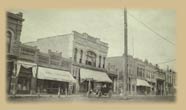

 1804 - 1862 (58 years)

